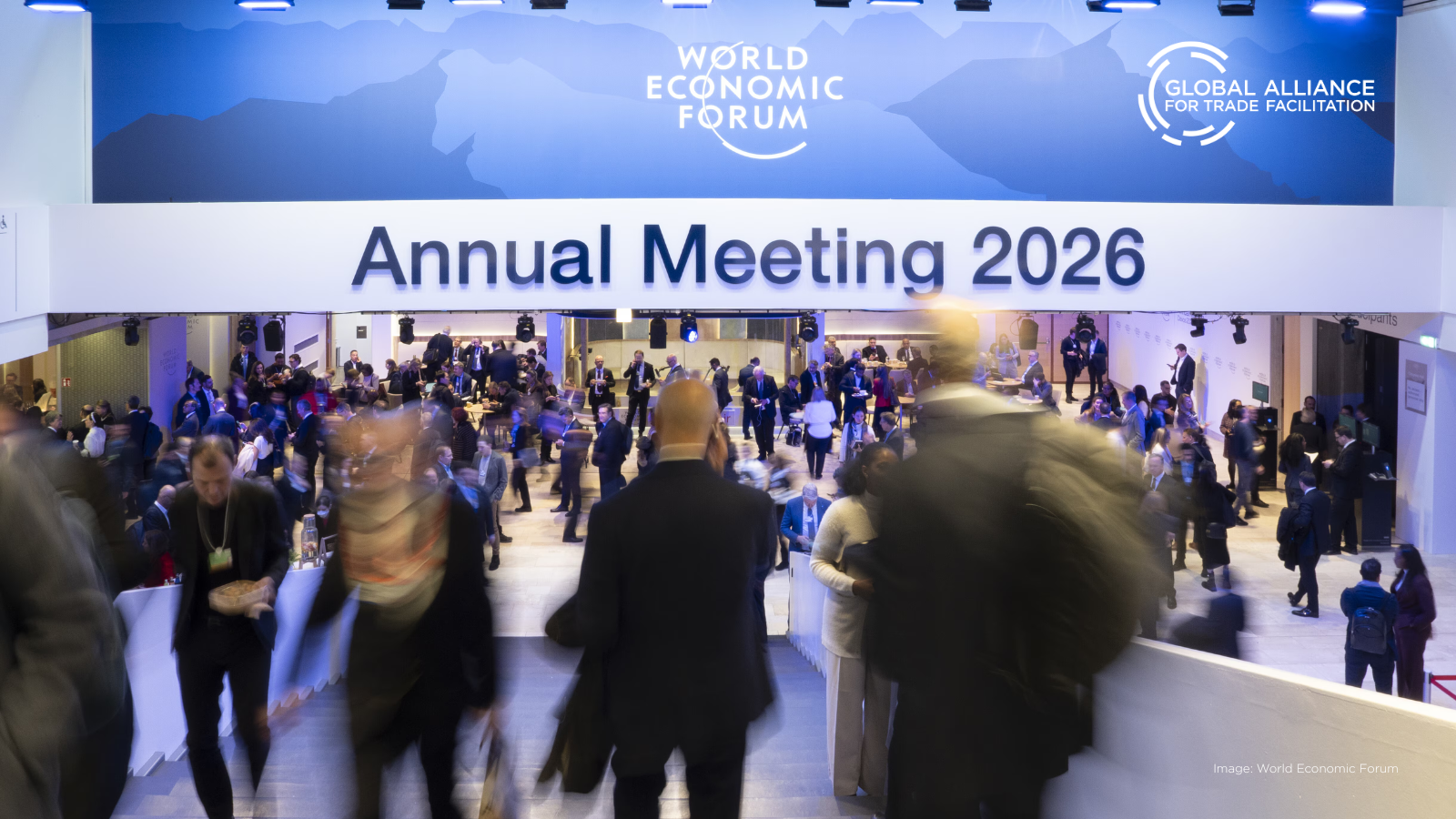
Geneva, 21 January 2026 – Against the backdrop of mounting geopolitical tensions and fragile supply chains, the Alliance convened global leaders at the World Economic Forum Annual Meeting in Davos for a forward-looking session on “Next Generation Trade Facilitation.” The discussion challenged conventional approaches and explored how trade facilitation must evolve to stay relevant in a rapidly changing global landscape.
Bringing together public and private-sector voices, the session examined how smarter regulation, stronger policy coherence and deeper collaboration can help trade systems absorb shocks and adapt to growing complexity.
Participants underscored that next-generation trade facilitation goes well beyond speeding goods across borders, calling for resilient, inclusive and adaptive systems capable of operating amid geopolitical tensions, regulatory fragmentation and repeated supply-chain shocks.
They highlighted the transformative potential of artificial intelligence, digitalisation and data-driven solutions, particularly for MSMEs and lower-tier suppliers that often lack the resources of large multinationals. When deployed effectively, these tools can level the playing field—democratising access to trade rather than merely optimising existing flows.
Measures related to sanitary and phytosanitary controls, veterinary requirements, food safety and technical standards were identified as among the most persistent bottlenecks to cross-border trade. Strengthening the use of global standards and mutual recognition was cited as one of the fastest ways to unlock trade at scale – reducing compliance costs, improving predictability and accelerating market access.
Enhancing Intra-regional Trade through Trusted Trader Programmes
The exchange also endorsed a broader shift: trade facilitation is increasingly a strategic policy tool, rather than a purely technical agenda. Its relevance now spans services trade, cybersecurity, trade finance, humanitarian supply chains, regional integration and MSME inclusion.
The Alliance’s Impact Around the World
Speakers were equally clear that while next-generation solutions are gaining momentum, first-generation trade facilitation remains unfinished business in many countries – particularly in least developed countries, where gaps in basic implementation efforts continue constrain trade.
The Alliance’s session at Davos reaffirmed the critical role of public-private collaboration in advancing practical, forward-looking trade facilitation reforms – ones that respond to today’s global challenges while laying the foundations for more resilient trade systems tomorrow.